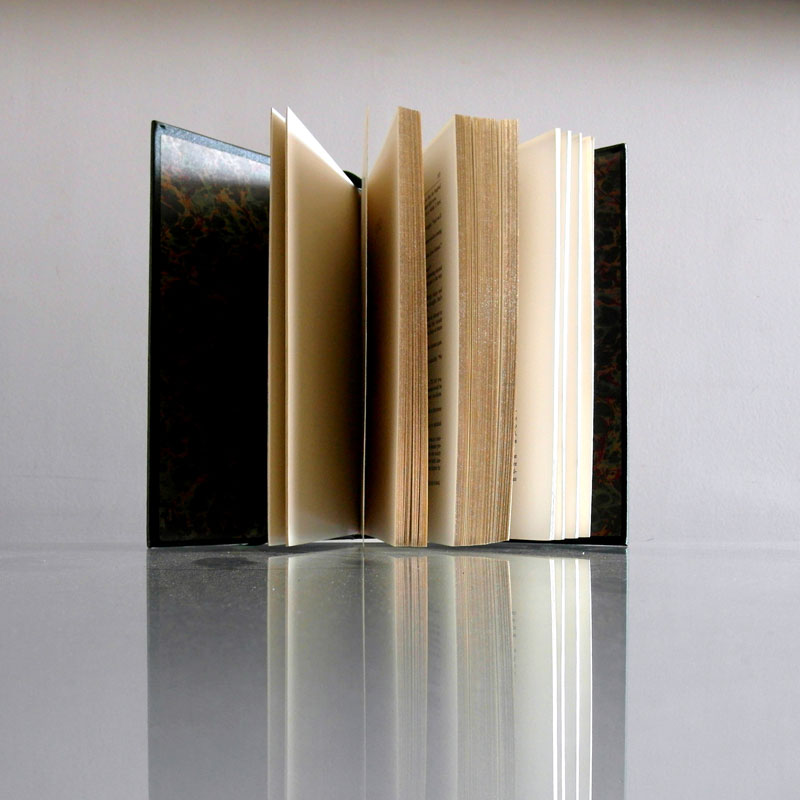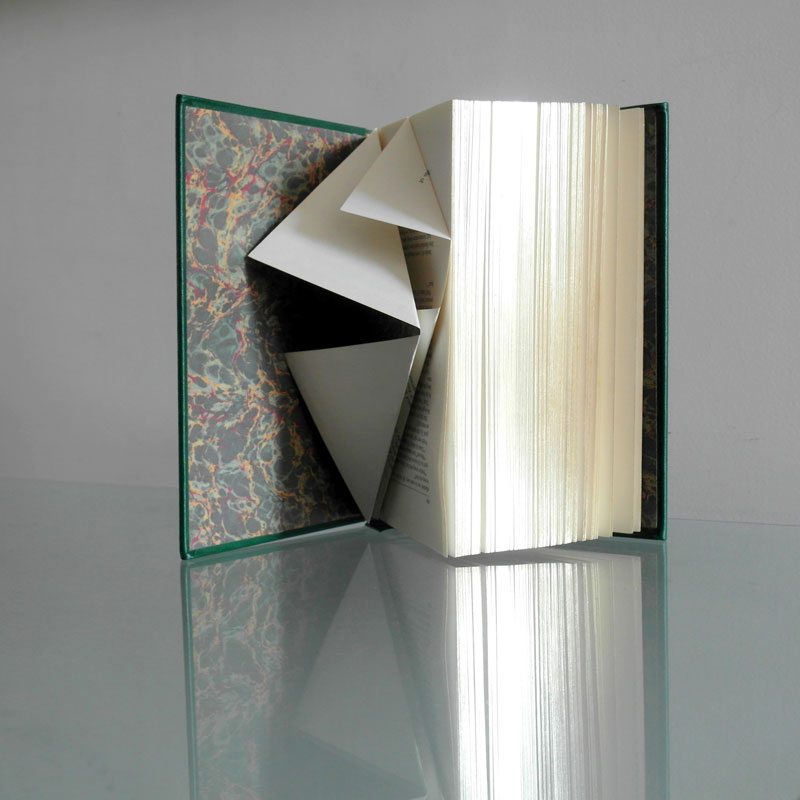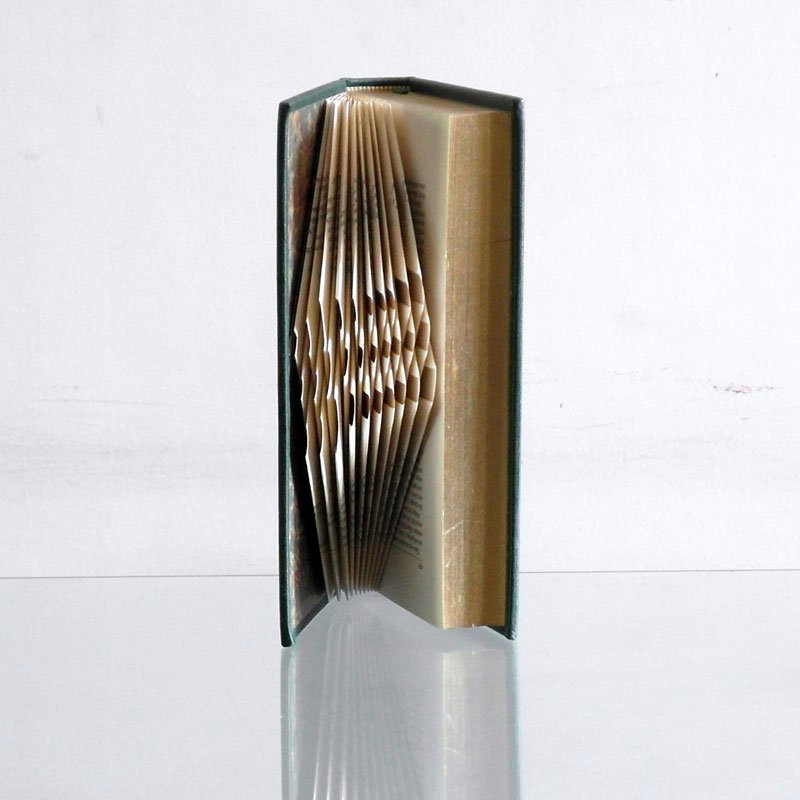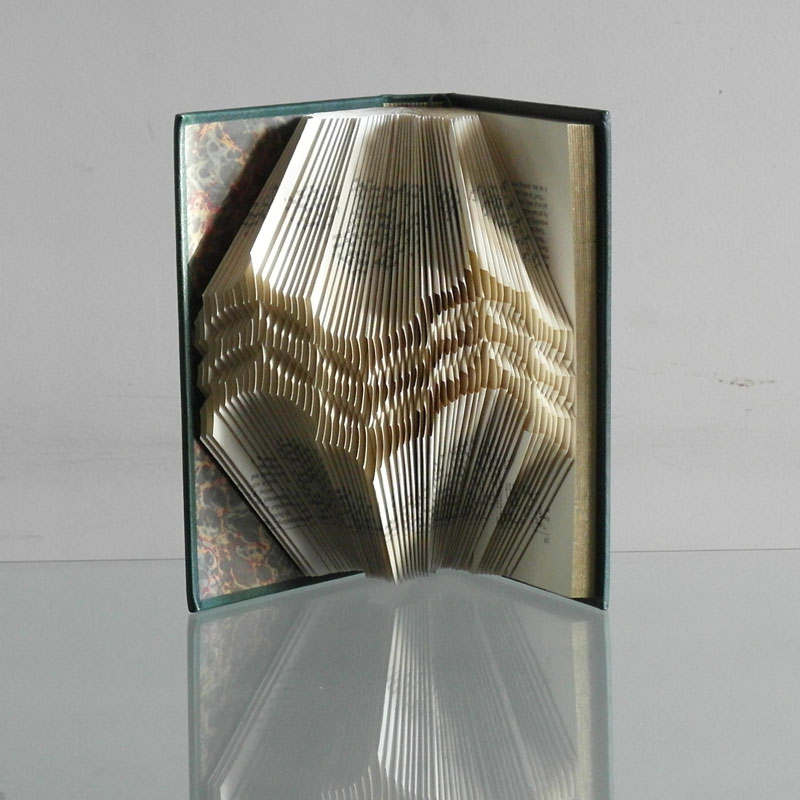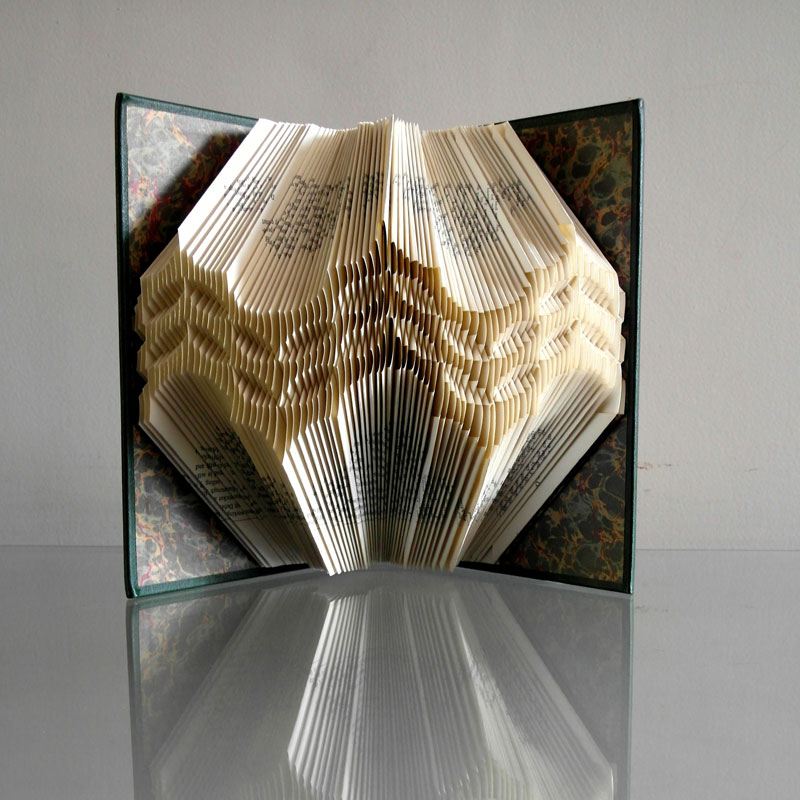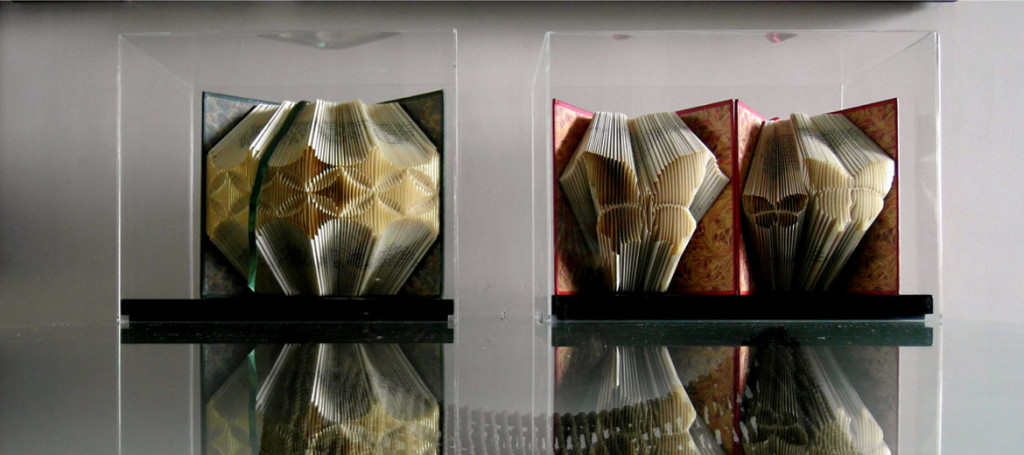
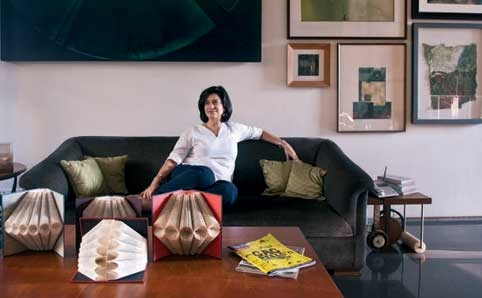
Banoo Batliboi is a self-taught paper artist who is impassioned about creating 'book art'. She works with old, abandoned books which have served for many years in their conventional form as a vehicle for narrative ideas. Now, by shifting focus to the tactile and visual qualities of the book, she imagines an alternative interpretation.
Ask her what inspired her to create these intriguing works and she says, "When I first I saw a book with folded pages I knew immediately that it was what I wanted to do. I started experimenting with what is a readily available raw material." We asked her what the hardest part of the process was, in creating these incredible pieces. "Well, it takes days and sometimes weeks to conceptualizing and plan the design. After that it is relatively easy and involves several hours of disciplined folding."
In this transformation that the book undergoes, the text block becomes a complex form, with the original text, deconstructing into a texture. The margins of each page create a white banding that defines the design.
After working for a while with regular hardcover books, she was lucky to find a cache of vintage leather bound books with gilt edged pages. These handsome books formed her PLUSH collection.
Banoo makes paper behave in surprising ways. The pages of old atlases restructure themselves into a new topography. Metallic paper becomes adornment for the neck with an unusual look and feel. And she makes you see paper in astonishing ways — further abstracting her book sculptures through her art photographs.
A book is a ubiquitous object that is often discarded when the owner tires of it or the subject matter is outdated. The way people read has changed dramatically. The disposal of old discarded books can actually be a problem and old tomes are often sent to landfills. I like to "save" beautiful old books from oblivion and find a new way to honor them in our lives.
The things that interest me when I'm working are: visual structure, surprise and anything that involves figuring things out. I'm drawn to systems and patterns and I love puzzling over these things. I love creating objects that invoke curiosity and joy.
Each old book comes with its own personal history. I feel a sense of connection with the books that I work with and see myself as one more event in the journey of their lives. I am aware that they were once conceived by someone, then born, loved, stored and finally discarded. Till I found them, studied them, folded them — and they were reborn.
While books were our main conduit of knowledge a few decades ago, there has been an enormous change in the ways in which people obtain information in the modern age. I see the book as a physical object — as a functional vessel or container. I know that the information it contains exists in several other repositories — other paper editions or digitally. So by manipulating a particular book itself, I believe I am not diminishing its actual content.
"While most of us leaf through the pages of a book, an artist here folds the pages meticulously, understanding the workings of scale, repetition, pattern as visual structure and text as graphic notation; in the process revealing the object-ness of a bound sheaf of same-sized papers and marked with a carpet of characters." — Hena Kapadia, DOMUS, Sept 2013
"I always think of the Aladdin story when I think of Banoo and her book sculptures, new lamps for old… Banoo 'knows'! That is Banoo's work. It is magic from patience, concentration and belief." — Sujatha Shankar Kumar, Writer & Photographer, Sept 2013
"It's thrilling to see books transform into sculptures. Batliboi does it well." — Georgina Maddox, Mail Today, 18 May 2012
"The aim she says is to alter the familiarity of the book so much so that it creates a 'perceptual tug of war between what we know the object is and what it has become.' She wants to continue the process of converting these works of fiction into works stranger than fiction." — Sharmila Ganesan-Ram, Times of India, 15 Aug 2010
"Old books are my raw material. I like working with common objects and making them behave in unexpected ways. I am intrigued by systems of logic that result in a visual structure, so I think of a page as a unit and then plot a precision fold on each of them. The books I use have between 400 to 700 pages. For me the motivation is to 'find the formula' or crack the code to enable the transformation. The complex form of the sculpture is a result of folding only. There is no cutting or sticking involved. I place a great importance on maintaining the integrity of the book — the challenge for me is to create the maximum transformation possible with a minimal intervention." — Banoo Batliboi